

An Analysis of the Natural Makeup Market
An Analysis of the Natural Makeup Market: 2025 Trends, Regulatory Frameworks, and Consumer Psychology
Section 1: The 2025 "Natural Look" Aesthetic: Deconstruction of an Evolving Consumer Ideal
The concept of "natural makeup" in 2025 has fragmented from a singular ideal into several distinct, co-existing aesthetics. This evolution reflects a market moving beyond simple "no-makeup makeup" to embrace authenticity, modular expression, and sophisticated, skin-forward textures.
1.1 The Foundational Philosophy: "No-Makeup Makeup" & The "Clean Girl" Aesthetic
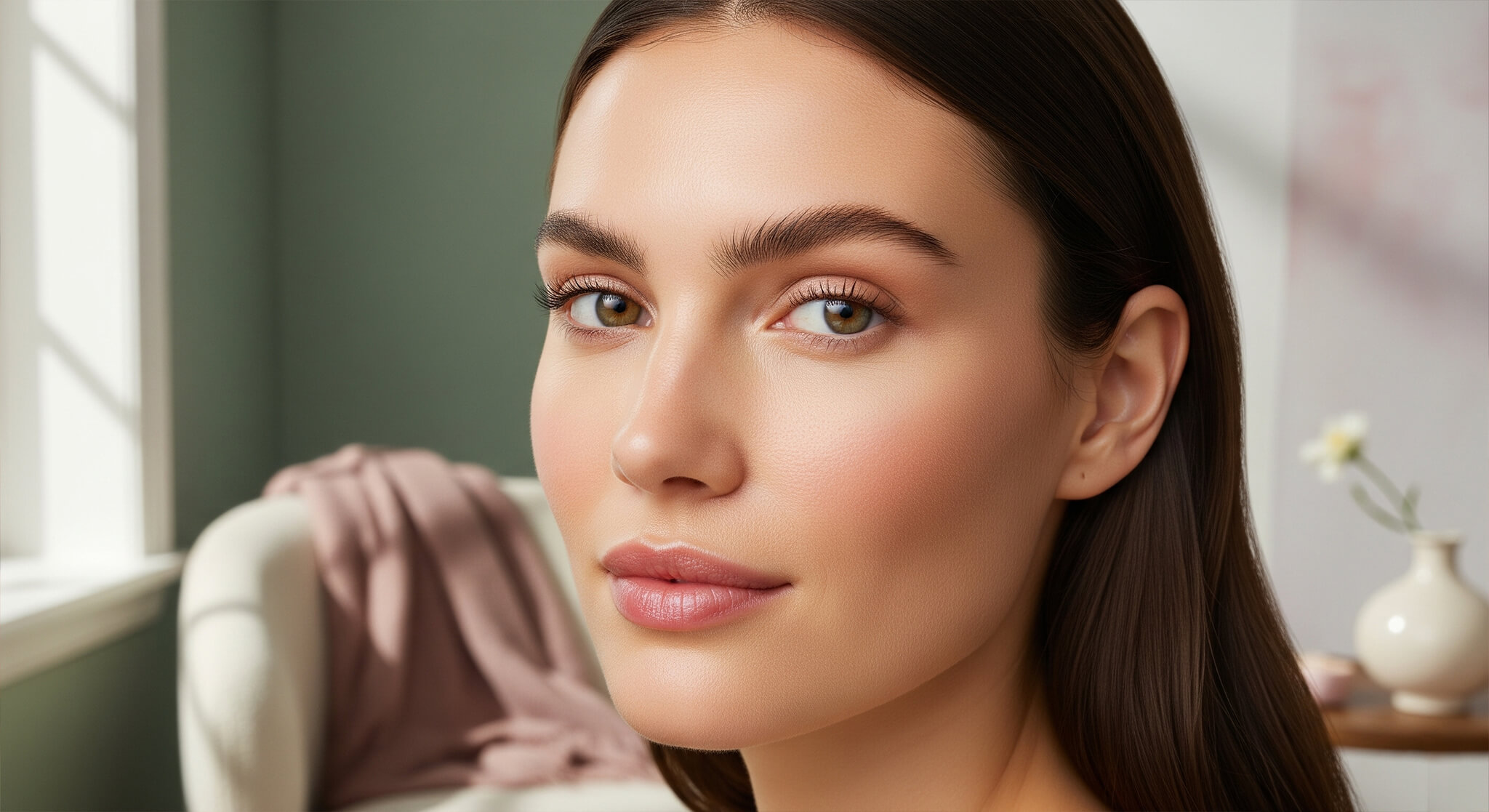
The baseline for all "natural" looks remains the "Clean Girl" aesthetic. This philosophy is not about covering flaws but about achieving "effortless elegance and natural radiance" by enhancing, rather than masking, one's natural features. The desired outcome is "skin that looks healthy, hydrated, and lived-in".
The key visual characteristics of this aesthetic are "dewy, glowing skin, brushed-up fluffy brows, subtle blush, and a soft, neutral lip". Achieving this look is critically dependent on a skin-first application process:
- Skin Prep: The routine begins not with makeup, but with skincare. A "radiant-boosting moisturizer" and hydrating serum are applied to a clean face to create a plump, hydrated canvas.
- Base: Heavy foundation is eschewed in favor of a lightweight skin tint, tinted moisturizer, or BB cream. The goal is to "even out skin tone... while letting your skin breathe".
- Brows: Brows are brushed upward with a clear or tinted gel to achieve the signature "fluffy" look.
- Cheeks: Cream blush is essential, tapped onto the apples of the cheeks to create a "natural flush" that appears to "melt into the skin".
- Lips: The look is completed with a sheer, neutral lip, typically a tinted lip balm or gloss.
1.2 Dominant 2025 Trend: "Dewy," "Satin," and "Butter" Skin Finishes
The primary signifier of a "natural" look in 2025 is the texture of the skin. The market has evolved to offer several specific finishes:
- "Dewy Makeup": This trend moves beyond simple highlighting to create an all-over "shiny, moisturized finish". It is achieved by infusing moisture at every step, starting with "ultra-hydrating skincare" and a "luminous base" like a serum foundation. Creamy formulas for blush and highlighter are non-negotiable, and the entire look is often locked in with a "dewy mist".
- "Satin Skin": This is a more recent and sophisticated evolution, positioned as the "sweet spot" between the "glazed, dewy" look and a "soft-matte" finish. The goal is skin that appears "smooth, healthy, and lightly radiant... like velvet with a hint of sheen". This more practical, realistic finish is achieved through "targeted mattifying"—using powder only in specific areas (like the T-zone) while allowing the rest of the skin to remain radiant.
- "Butter Skin": This related concept, emerging from the "no-makeup makeup" philosophy, advocates for "velvety, natural-looking skin" that avoids full-coverage foundation.
The progression from the "glazed donut" dewy look to the more wearable "satin" finish signals a market maturation. Consumers are seeking a realistic, "like skin" radiance that is practical for everyday wear.
1.3 The 2025 Evolution: "Subtle Under-Eyes" and "Lived-In Glam"
A significant counter-trend has emerged in 2025, reacting against the unattainable perfection of the "Clean Girl" aesthetic. This new look is "surprisingly subversive" and embraces an "intentionally messy vibe". It is defined by "letting your ~imperfections~ go unconcealed".
The key technique for this aesthetic is the "Subtle Under-Eye". This involves deliberately "put[ting] down the full-coverage concealer". Makeup artist Patrick Ta explains that while a "lightweight serum-based formula... won't completely cover up your dark circles," it ultimately "looks so much fresher". This philosophy, which Ta calls "lived in glam," prioritizes "effortlessly chic looks that really bring out your natural radiance" without appearing overly polished.
This trend moves further into a "party-girl" vibe, with some artists "foregoing concealer altogether and going for this grungey, shadowy look on your eyes". This is a significant psychological shift. The "Lived-In Glam" trend lowers the barrier to entry, redefining "natural" to include signs of life like dark circles, thereby shifting the consumer ideal from "flawless" to "authentic."
1.4 The 2025 Paradox: "Minimal Skin, Maximalist Eyes"
This trend represents the full fragmentation of "natural" as an all-encompassing look. It "means emphasizing your natural skin texture—even skipping foundation entirely... yet keeping the eyes bold".
This aesthetic is a "beautiful" and "wearable" contrast that breaks traditional makeup rules, which typically paired a "heavy eye look" with "heavy skin" or full-glam coverage. This paradox signifies that "natural" has become a modular concept. A consumer can select "natural skin" as a base layer while simultaneously engaging in bold, creative expression with "maximalist eyes".
This creates a dual-track market. Brands must now cater to the consumer who is buying both a skin tint or serum concealer for their "natural" base and a bold eyeliner or high-drama mascara for their "maximalist" feature. In 2025, the consumer is no longer just "natural" or "glam"; she is often both at the same time.
Table 1.1: The 2025 "Natural" Aesthetics Matrix
|
Aesthetic |
Philosophy |
Key Skin Finish |
Key Features |
Key Products |
|
"Clean Girl" / "No-Makeup Makeup" [1, 2, 4] |
Effortless Elegance |
Dewy or Satin |
Fluffy Brows, Subtle Blush, Neutral Lip |
Skin Tint, Cream Blush, Brow Gel, Lip Balm |
|
"Lived-In Glam" / "Subtle Under-Eyes" |
Authentic Realness |
Skin-Like, Unconcealed |
Shadowy Under-Eyes, Messy Vibe |
Serum Concealer (used lightly or not at all), Cream Blush |
|
"Minimal Skin, Maximalist Eyes" |
Modular Expression |
Barely-There, Natural Texture |
Bold, Dramatic Eyes (liner/shadow) |
Skipped Foundation, Bold Eyeliner, Volumizing Mascara |
Section 2: Decoding the Vocabulary: A Legal, Scientific, and Consumer Analysis of Industry Terminology
The "natural makeup" movement is built on a lexicon of terms that are, from a regulatory and scientific perspective, poorly defined and highly confusing.
2.1 The "Clean Beauty" Movement
"Clean" refers to cosmetic products formulated without a specific, brand-defined list of "potentially harmful or controversial ingredients". This is the most crucial distinction: "clean" is not synonymous with "natural." "Clean" beauty "doesn't shy away from synthetic (or lab-created) ingredients—as long as those synthetic ingredients are safe".
The term "clean" is not regulated by the US Food and Drug Administration (FDA) nor is it an official, harmonized term in the European Union. Its definition is established by private entities, primarily brands and retailers. The "Clean at Sephora" seal, for example, defines "clean" as products formulated without phthalates, formaldehyde and its releasers, triclosan, oxybenzone, and other specific ingredients.
2.2 The "Non-Toxic" Fallacy: A Toxicological Perspective
The term "non-toxic" is frequently used in marketing to "suggest that a product is safe". From a toxicological standpoint, this term is scientifically and legally meaningless. "Scientifically speaking, nothing is nontoxic. Even water, in large doses, can be harmful".
In the United States, there is no legal definition or federal standard governing the use of the term "non-toxic" for cosmetics. The Toxic Substances Control Act (TSCA) explicitly does not cover cosmetics. Similarly, the FDA does not regulate the associated term "hypoallergenic," stating it "means whatever a particular company wants it to mean". Therefore, "non-toxic" is purely a marketing "buzzword", often used in "greenwashing".
2.3 The "Natural" Paradox: Health, Irritation, and Consumer Safety
The clean beauty market is overwhelmingly driven by the consumer belief that "clean beauty products are safer than traditional products" and that "natural" ingredients are "gentler on sensitive skin".
This belief is often false. Dermatological evidence shows that "natural and organic ingredients are not always safe for your skin". In fact, "high concentrations of botanical extracts are a leading cause of skin irritation, allergic reactions, and increased skin sensitivity to UV light". As noted by Dr. Sandra Hong of the Cleveland Clinic, many "natural" substances, like poison ivy, are potent irritants. The "clean" movement has, in some instances, "replaced traditionally safe ingredients with unsafe alternatives and has contributed to an uptick in contact dermatitis". Essential oils, widely used as "natural" fragrances, are among the most common allergens.
The marketing of "clean" and "natural" beauty has created a widespread consumer phobia of "chemicals", particularly synthetic preservatives like parabens. However, preservatives play an essential role in preventing the growth of harmful bacteria, yeast, and mold. The unscientific drive to remove these effective preservatives has led to two significant negative outcomes: 1) their replacement with "natural" alternatives (like botanical extracts) that are often more allergenic, and 2) the proliferation of products with "shorter shelf life" that may expire or become contaminated more quickly.
The consumer is often unknowingly trading a low, hypothetical risk (e.g., from regulated parabens) for a high, actual risk (e.g., allergic contact dermatitis or bacterial contamination).
Table 2.1: Comparative Glossary of "Natural" Terminology
|
Term |
Core Definition |
Key Ingredients Excluded |
Regulated? |
Common Certification |
|
"Clean" [16, 18] |
Formulated without a specific list of controversial (synthetic or natural) ingredients. |
Parabens, Phthalates, Sulfates, Formaldehyde-releasers.[16, 22, 35] |
No. Defined by retailers (e.g., "Clean at Sephora"). |
Retailer Seals (Sephora, Credo). |
|
"Natural" [36, 37] |
Ingredients are "from natural origins" (plants, minerals).[36] |
Often implies no synthetic chemicals [16], but this is not guaranteed. |
No. Unregulated term in US/EU.[21, 37, 38] |
COSMOS NATURAL, ISO 16128 (voluntary guideline). |
|
"Organic" [19, 36] |
Ingredients are "organically farmed materials" [36] without synthetic pesticides/fertilizers. |
GMOs, synthetic pesticides/fertilizers. |
Yes, but... In the US, the USDA certifies agricultural ingredients, but the FDA does not regulate the term on cosmetic labels. |
USDA Organic (if 95-100% organic), COSMOS ORGANIC. |
|
"Vegan" [36, 41] |
Contains no animal products, by-products, or extracts.[36] |
Animal ingredients (e.g., beeswax, carmine) and derivatives (e.g., honey, milk).[36, 41] |
No. A voluntary claim. |
The Vegan Society, PETA. |
|
"Cruelty-Free" [16, 42] |
No animal testing was performed on the final product or its ingredients. |
(Not applicable). |
Complicated. Animal testing for cosmetics is banned in the EU [43], but claims in the US are not well-regulated. |
Leaping Bunny Certified.[44] |
|
"Non-Toxic" |
Marketing term implying safety and no harmful ingredients. |
(Not defined). |
No. Legally and scientifically meaningless. |
None. (A marketing "buzzword"). |
Section 3: The Regulatory & Compliance Landscape (2025): EU vs. US
The global cosmetics market is governed by vastly different regulatory philosophies. The European Union, with its precautionary approach, has established the de facto global standard for safety.
3.1 The EU Standard: Regulation (EC) No 1223/2009
The primary legal framework for all finished cosmetic products in the EU is Regulation (EC) No 1223/2009. This regulation is built on a "precautionary principle," meaning substances with suspected harm can be banned or restricted.
The most significant part of this regulation is Annex II, the list of prohibited substances. As of May 2025, the EU prohibits 1,703 substances from use in cosmetic products. This stands in stark contrast to the US FDA, which prohibits or restricts only 11 chemicals by law.
The EU's regulatory list is dynamic. Key 2025 updates include:
- CMRs (Carcinogenic, Mutagenic or Toxic to Reproduction): In May 2025, Regulation (EU) 2025/877 added a new group of CMR substances (including benzene and formaldehyde) to the prohibited list.
- Endocrine Disruptors (EDCs): Parabens and the UV filter Benzophenone-3 are under high scrutiny.
- PFAS: Long-chain per- and polyfluoroalkyl substances, linked to cancer, are a key target for bans.
- TPO (trimethylbenzoyldiphenylphosphine oxide): This chemical, widely used in gel nail polishes, was classified as toxic to reproduction and is banned from cosmetic use in the EU effective September 1, 2025.
This vast difference between the EU's "precautionary" ban and the US FDA's "reactive" model has created a global compliance reality. Brands that wish to sell in both markets are increasingly formulating to the stricter EU standard by default. In effect, EU regulations are providing more protection to US consumers than US law.
3.2 Substantiating Claims: The EU "Common Criteria" and ISO 16128
A critical regulatory gray area exists: if terms like "natural" are not legally defined, how can brands be held accountable?
Instead of defining the terms, the EU regulates the claims themselves through Commission Regulation (EU) 655/2013, which establishes six "Common Criteria". All cosmetic claims must be in legal compliance and backed by Truthfulness, Evidential Support, Honesty, and Fairness.
This means a brand claiming its product is "natural" must have evidential support to prove it. To create a standardized method for this "evidential support," the industry relies on ISO 16128. This is a voluntary guideline, not a law. It provides a technical framework for companies to calculate the percentage of "natural" and "organic" ingredients in their finished products.
3.3 Certification Deep Dive: ECOCERT vs. COSMOS
In the absence of a single legal definition, third-party certifications have become the primary tool for brands to gain consumer trust. ECOCERT and COSMOS are the most respected standards in the EU.
- What is COSMOS? The COSMOS-standard is the current, high-level unifying standard for organic and natural cosmetics. It was created as a non-profit association by the five largest European certification bodies (including Ecocert) to create one harmonized, stricter standard.
- What is ECOCERT?ECOCERT is one of the founding members of COSMOS and is now an authorized certification body that audits products to the COSMOS-standard.
Consumers will see two primary COSMOS signatures:
- COSMOS ORGANIC: This is the highest standard. It requires that a minimum of 95% of the plant-based ingredients are organic, and that a minimum of 20% of the total formula (including water) must be organic (10% for rinse-off products).
- COSMOS NATURAL: This standard requires that all ingredients are from natural origin (or a small restrictive list) but "does not require a minimum proportion of organic ingredients". On average, products certified to this level contain 99% ingredients of natural origin.
The 20% organic requirement for the total formula is the single most difficult metric for brands to meet, as many formulas are 50-80% water. A "COSMOS ORGANIC" logo signifies a product that has cleared an extremely high formulation and sourcing bar.
Section 4: Navigating Consumer Skepticism: Greenwashing and Market Transparency
"Greenwashing"—the practice of misrepresenting environmental or health claims to appeal to eco-conscious consumers—is rampant in the beauty industry. It is the direct result of high consumer demand combined with the lack of clear, legal definitions.
4.1 A Field Guide to Greenwashing Tactics
Greenwashing manifests in several common tactics:
- Vague or Broad Claims: Using ambiguous terms like "green," "eco-friendly," "sustainable," or "natural" without any clear definition or certification.
- Misleading Labels & Imagery: Employing "green" packaging colors and natural imagery (leaves, flowers) to imply a product is natural, even when the formula is synthetic.
- Selective Transparency (The Hidden Trade-off): Highlighting one positive attribute while ignoring a larger, related negative one. (e.g., L'Oreal and Head & Shoulders being "called out" for claims of a "100% recycled plastic bottle" when the cap was not).
- Irrelevant Claims: Making a "green" claim that is legally mandated or meaningless (e.g., a deodorant claiming to be "CFC-Free," when CFCs have been banned for decades).
- Lesser of Two Evils: A brand marketing its sunscreen as "reef-friendly" because it is free of two well-known harmful chemicals (oxybenzone, octinoxate), even though it may contain other ingredients harmful to marine life.
- Outright Fibbing: Making factually false claims, such as marketing mink-fur lashes as "cruelty-free".
4.2 The Antidote: The 2025 EU "Green Claims Directive"
The most significant regulatory development to combat this deception is the EU's forthcoming "Green Claims Directive." This new regulation is designed to make "greenwashing" illegal and punishable by targeting vague claims.
The directive mandates that companies must be able to prove their environmental claims before they are marketed to consumers. Key provisions include:
- Scientific Substantiation: Companies must use "credible scientific evidence" to support all claims.
- Third-Party Verification: Environmental claims must be "verified by independent experts before they are published".
- Carbon Offset Clarity: Claims about "carbon neutrality" must be transparently detailed.
This directive represents a fundamental change. The "Common Criteria" stated, "you must have proof if asked." The new "Green Claims Directive" states, "you must have your proof pre-verified by a third party before you can even make the claim."
This regulation will effectively kill "casual greenwashing." Vague, non-quantifiable terms like "eco-friendly" or "green" will become unusable, as they cannot be scientifically verified.
Table 4.1: Greenwashing Red Flag Index
|
The Claim |
The Hidden Reality (The "Greenwash") |
The Expert Question to Ask |
|
"Eco-Friendly / Green" |
This term is vague and undefined. It has no legal or scientific meaning. |
"In what specific, measurable way is this product 'eco-friendly'?" |
|
"Natural" [37, 55] |
Unregulated term. Can mean just 1% of the formula is plant-derived. |
"What percentage of this product is from natural origin, calculated via ISO 16128? Is it COSMOS NATURAL certified?" |
|
"Organic" [55] |
Unregulated unless certified. A brand can claim "organic" with only one organic ingredient. |
"Is this product 'COSMOS ORGANIC' or 'USDA Organic' certified? What is the total organic percentage?" |
|
"Non-Toxic" |
Scientifically and legally meaningless. |
"This is a marketing term. Which specific ingredients does this brand avoid, and why?" |
|
"100% Recycled Bottle" |
Often selectively transparent. The claim may only refer to the bottle, not the cap, pump, or label. |
"Is 100% of the entire packaging, including the cap and pump, made from recycled materials?" |
|
"Reef-Friendly" |
No legal definition. Often just means "Oxybenzone-free." It may contain other chemicals that harm reefs. |
"Which specific UV filters does this sunscreen use? Is it a non-nano mineral (Zinc Oxide, Titanium Dioxide) formula?" |
Section 5: Performance, Price, and Market: A Comparative Analysis
5.1 The Performance Gap: Longevity, Pigmentation, and Shelf Life
The primary consumer hesitation regarding natural makeup is its performance versus conventional products. This "performance gap" is a well-documented trade-off.
- Conventional Makeup (The Pros): Formulated for "strong performance." Offers "bold, vibrant colours," an "extensive range of shades," and "longer shelf life (12-36 months)".
- Natural/Organic Makeup (The Cons):
- Longevity: "May require more frequent touch-ups".
- Pigmentation: Use of natural colorants results in a "limited" shade range. It is especially difficult to achieve "bright eyeshadows" or "intense lipsticks", with hues typically being more "natural, subtle".
- Shelf Life: A significantly "shorter (6-12 months)" shelf life is common, a direct consequence of using weaker natural preservatives.
Consumers are faced with a direct choice: the "skin-health" and "eco-friendly" benefits of natural makeup often come at the expense of performance, shade range, and product lifespan.
5.2 The "Clean Tax": Analyzing Cost Structure and Consumer Perceptions
"Clean beauty" products are "often more expensive than mainstream beauty products". This "higher cost" is identified as a key restraint on the market's growth. This "Clean Tax" is driven by:
- Sourcing: "Natural and organic ingredients" are "more expensive to source and produce".
- Certification: The rigorous process of obtaining third-party certifications like COSMOS is a significant expense.
- Formulation: Developing stable, high-performance formulas without traditional preservatives is a costly R&D challenge.
However, a more recent consumer complaint has given rise to a "Performance Tax." Consumers are observing that "clean" reformulations from luxury brands (such as Chanel and Dior) have resulted in poorer quality products. Reports include foundations "going bad quicker," eyeliners "hardening" after a few months, and powder eyeshadows "hard panning" (becoming unusable).
This "Clean Tax" is therefore not just a higher initial purchase price; it is a higher total cost of ownership. If a "clean" eyeliner that hardens in 6 months is 4x more expensive to own than its conventional counterpart that lasts 24 months, this creates a "clean beauty bubble" where marketing promises are failing to match the product experience.
5.3 Market Dynamics & Consumer Demand (2025-2030)
Despite these trade-offs, the clean and natural market is "redefining the global beauty narrative" and growing at a phenomenal rate.
The global clean beauty market was estimated at USD 8.25 billion in 2023 and is projected to reach USD 21.29 billion by 2030, reflecting a compound annual growth rate (CAGR) of 14.8%. The natural and organic cosmetics market is similarly projected to grow from USD 1.65 billion in 2024 to USD 3.45 billion by 2032.
This explosive growth is "driven by increasing consumer concerns about the safety of cosmetic products" and represents a "fundamental shift in consumer attitudes". Consumers believe these products are safer, and this belief is a more powerful purchasing motivator than price or performance. This demonstrates that the "natural makeup" movement is not a functionally-driven trend; it is an emotional and identity-based one. The 2025 consumer is not just buying a lipstick; they are buying "safety", "transparency", and "environmental sustainability".
Section 6: The 2025 "Natural Makeup" Marketplace: Key Brands and Retailers (Netherlands Focus)
6.1 2025 "Best-in-Class" Products (Global)
Based on performance reviews and retailer best-seller lists, the following products have become "clean" and "natural" category leaders:
- Mascara:
- ILIA Limitless Lash Mascara: Praised for its patented dual-sided wand that delivers "length and separation". It is non-clumping and uses 100% natural dyes.
- Tower28 MakeWaves Mascara: A cult favorite "great for sensitive eyes" that "doesn't leave your lashes crunchy".
- Well People Expressionist Mascara: A high-performance, "EWG verified" option at a budget-friendly price, known for "volume".
- Westman Atelier Eye Want You Mascara: A luxury, "clean" mascara designed for "clean, defined lashes with a soft finish".
- Foundations / Skin Tints:
- ILIA Super Serum Skin Tint SPF 40: A top-seller at Sephora, this product merges serum, SPF, and sheer, dewy coverage.
- Kosas Revealer Skin-Improving Foundation / Concealer: A Sephora staple, beloved for its creamy, skin-loving formula with hyaluronic acid.
- HAUS LABS Triclone Skin Tech Foundation: A high-tech "clean" foundation, popular at Sephora, that uses fermented arnica.
- Lip Tints & Balms:
- ILIA Balmy Tint Hydrating Lip Balm: A "clean tinted lip balm with active levels of moisture-boosting ingredients".
- Benefit Benetint: A classic lip and cheek stain, though some users note it "doesn't seem to last all day".
6.2 Leading European Vegan & COSMOS-Certified Brands
- Nui Cosmetics (Germany): A PETA-certified vegan brand offering a wide range of products in eco-friendly packaging.
- Byena Beauty (Germany): PETA-certified vegan, this brand uses organic ingredients and features plastic-free, refillable packaging.
- Purodoré (Finland): A "Nordic luxury" brand using natural ingredients like gold, champagne, and cloudberry.
- VALYXIR (Switzerland): A COSMOS-certified brand that leverages Swiss alpine flowers and clinically-proven active ingredients.
- Other Notables: The official COSMOS directory lists thousands of certified products from well-known brands like Weleda, LOGOCOS Naturkosmetik, and Natura Siberica.
6.3 The Netherlands Retail Ecosystem: Online
For consumers in the Netherlands, a robust online market provides access to "clean" brands:
- Ecco Verde (ecco-verde.com): A major European online retailer specializing in a vast selection of "natural & organic cosmetics".
- Nourished.nl: A Dutch online boutique that curates high-end clean and natural brands, including Ere Perez and Innersense.
- Dutch Health Store (dutchhealthstore.com): Focuses on "purest, natural and organic products" with easy, custom-free shipping within the EU.
- Specialized Retailers for Key Brands:
- Kosas: Available to ship to the Netherlands via Niche Beauty (niche-beauty.com) and Space NK (spacenk.com).
- ILIA Beauty: Has an official Benelux partner site at iliabeauty.nl.
6.4 The Netherlands Retail Ecosystem: Amsterdam Physical Stores
For in-person shopping in Amsterdam, the "natural makeup" landscape is divided between luxury department stores and specialized niche boutiques:
- Premium Department Stores:
- De Bijenkorf (Dam Square): Amsterdam's most luxurious department store. Its large beauty department is the best starting point for high-end, mainstream brands that have "clean" formulations, such as Aesop, DECIEM, Kiehl's, and NARS.
- Specialized Boutiques (The "True Clean" Destinations):
- Skins: A high-end niche boutique with several locations, this is the key physical retailer for ILIA Beauty in the Netherlands.
- Babassu Beauty (Cornelis Schuytstraat): Described as a "cosmetics Valhalla", this posh Zuid boutique stocks "iconic brands with a story," including niche and organic lines like The Organic Pharmacy and Tata Harper.
- Haru Haru Beauty (9 Streets): A K-Beauty specialist, offering innovative, skin-first formulations from Korea.
- Health & Natural Stores:
- Holland & Barrett (formerly De Tuinen): A major chain with multiple locations, this is a reliable source for mass-market natural and organic brands.
- Lavendula (Westerstraat): A "bio boutique" in the Jordaan neighborhood specializing in organic, fair-trade, and cruelty-free products.
Table 6.1: Amsterdam "Natural Makeup" Retail Guide
|
Retailer |
Location |
Vibe |
Key "Natural/Clean" Brands |
|
De Bijenkorf |
Dam Square |
Luxury Department Store |
Aesop, DECIEM, Kiehl's, NARS (high-end, mainstream). |
|
Skins |
(Multiple, e.g., Runstraat) |
High-End Niche Boutique |
ILIA Beauty, (Other niche skincare/perfume). |
|
Babassu Beauty |
Cornelis Schuytstraat, Zuid |
Posh Cosmetics "Valhalla" |
The Organic Pharmacy, Tata Harper, Delilah Cosmetics. |
|
Holland & Barrett |
(Multiple locations) |
Health & Wellness Chain |
Mass-market natural brands (e.g., Weleda, Dr. Organic). |
|
Lavendula |
Westerstraat, Jordaan |
"Bio Boutique" |
Specialized organic and fair-trade brands. |
|
Haru Haru Beauty |
Hartenstraat, 9 Streets |
K-Beauty Specialist |
Innovative Korean skincare and makeup brands. |
Section 7: Conclusion
The "natural makeup" sector in 2025 is defined by a fundamental and growing tension. On one side, a powerful psychological and emotional consumer drive for "safety," "authenticity," and "sustainability" is propelling market growth at a phenomenal rate. This emotional investment often outweighs practical considerations of price or performance.
On the other side, this movement is built on a foundation of scientifically vague, unregulated, and often dermatologically misleading terminology. This has led to rampant greenwashing and, in a significant paradox, the creation of products that can be more irritating or have poorer performance and shorter lifespans than their conventional counterparts.
The 2025-2026 period will be defined by a regulatory "correction." New EU mandates, particularly the "Green Claims Directive", will force brands to substantiate their claims with scientific, third-party verified proof. This will separate marketing-led brands from the truly compliant, creating a more transparent but challenging market. The future will belong to brands that can successfully navigate the EU's stringent compliance framework (e.g., COSMOS) while simultaneously closing the performance and price "tax" that currently frustrates consumers.
References
- Perfect Corp:10 Must-Try Makeup Aesthetics of 2025
- L'Oréal Paris USA:A Step-by-Step Guide to TikTok's Clean Makeup Look
- https://artofdermatology.com/greenwashing-and-the-reality-of-skin-care-labeling/
- https://sylvaia.com/the-art-of-invisible-makeup-a-complete-guide-to-a-natural-effortless-look/